Living Planet Index


The Living Planet Database in Policy
The Living Planet Index (LPI) uses primary data on vertebrate species populations to track trends in abundance. The living planet database (LPD) holds the underlying data for the LPI. The database has an additional role as a resource for global biodiversity research. The LPD is the largest available repository for vertebrate population abundance data. This resource is now widely used in conservation and research. See the Publications page for examples of the research. These types of primary data are fundamental for understanding global biodiversity change and informing models which predict future change.
Ancillary data on ecology, local threats and conservation management are also recorded in the database. This has enabled a range of research topics to be explored such as measuring the effectiveness of protected areas, understanding trends in groups of species such as mammals, reptiles, freshwater megafauna, forest species, and migratory species, and analysing how populations respond to different threats like land use and climate change.
The LPD is directly related to the Target 20 of the Kunming-Montreal Global Biodiversity Framework, as it is a source of “relevant knowledge”.
Database growth over time
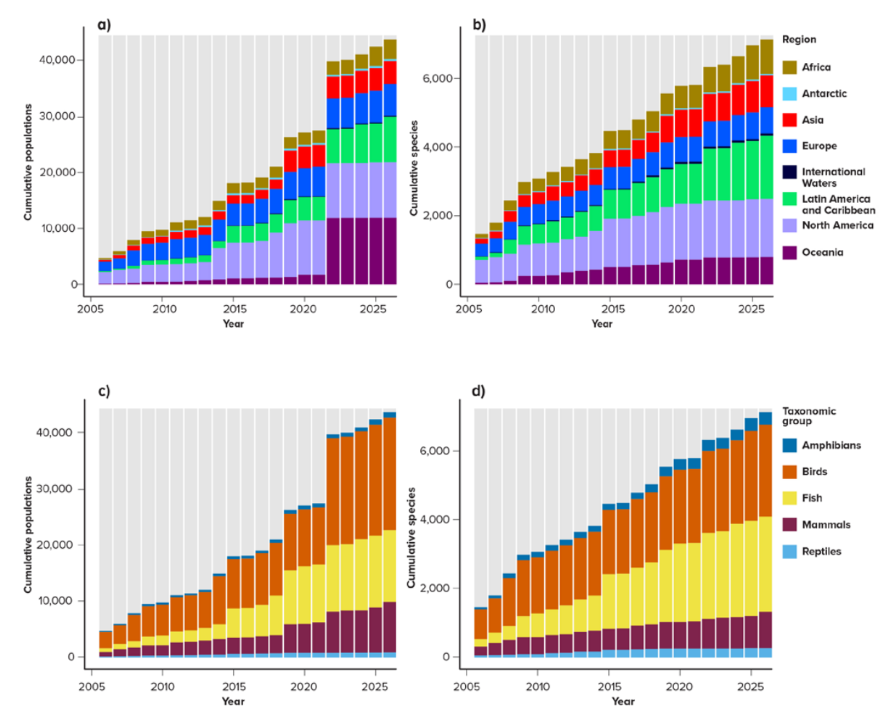
The LPD continues to grow overtime and is continually updated, with new data added for an increasing number of species and regions, improving the geographic and taxonomic representation. Since the online database was established in 2006, the time and data of each entry is saved with the record. This allows us to track the how many populations and species are added over time.
See the figure below for growth in the number of species and populations in the Living Planet Database by region and taxon. Please note the numbers in 6b add up to more than the total number of species in the database as some species occur in more than one region. There are currently 41994 populations of 5570 vertebrate species in the database. The relatively steady increase over time has been punctuated by a few steep increases in records which coincide with the completion of certain reports and projects.